
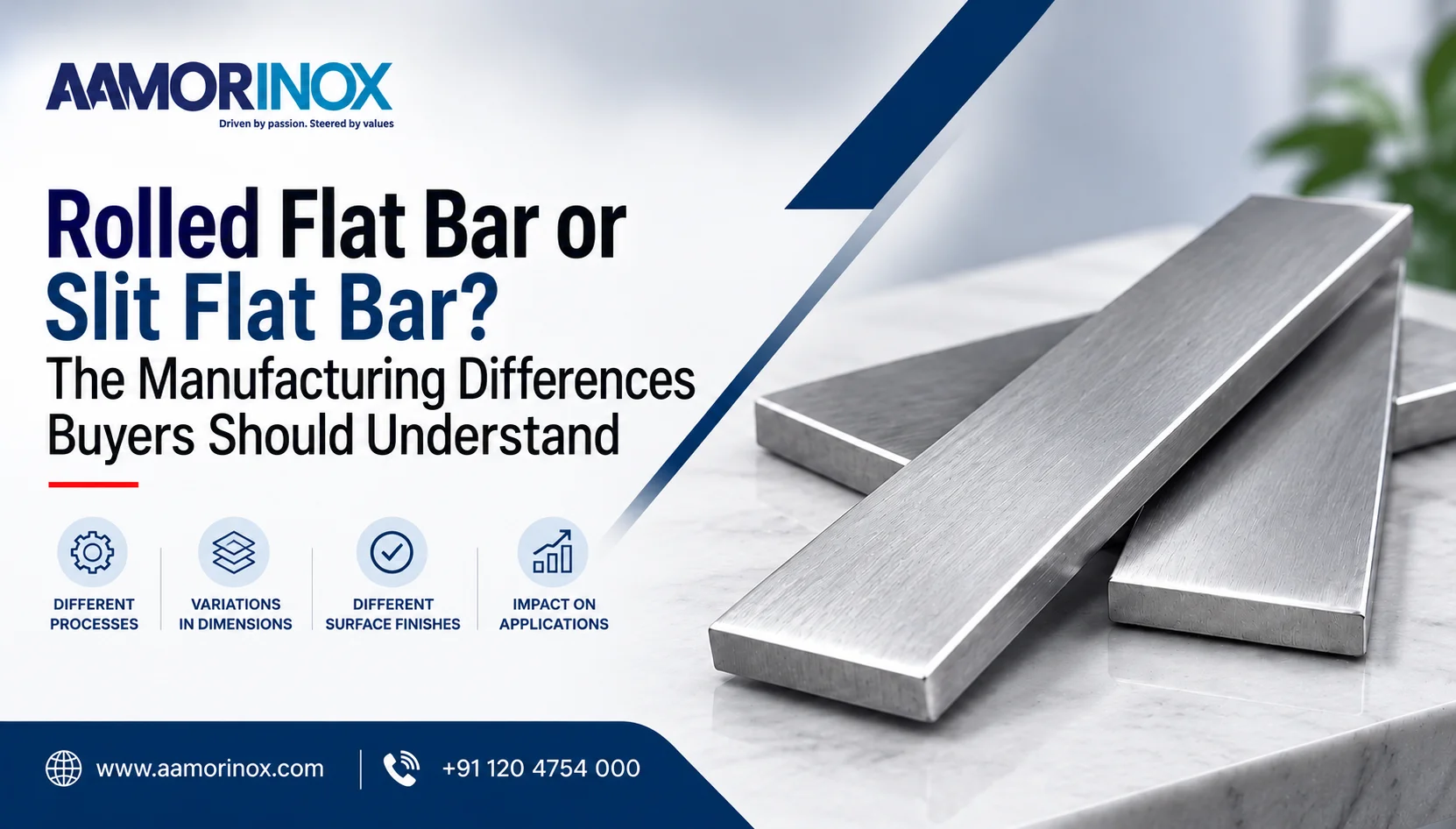
Rolled Flat Bar or Slit Flat Bar? The Manufacturing Differences Buyers Should Understand
Two stainless steel flat bars can carry the same grade and nominal dimensions - and still behave differently at the saw, machining center, welding fixture or inspection bench.
The reason is often the product route. A rolled flat is formed as a bar sectional slit flat is cut longitudinally from wider coil, strip or plate. That distinction can influence edges, geometry, surface condition, tolerances and preparation cost.
Neither route is universally better. The right choice depends on which surfaces remain in the component, how the material will be processed and which specification governs acceptance.
What Is a Rolled Stainless Steel Flat Bar?
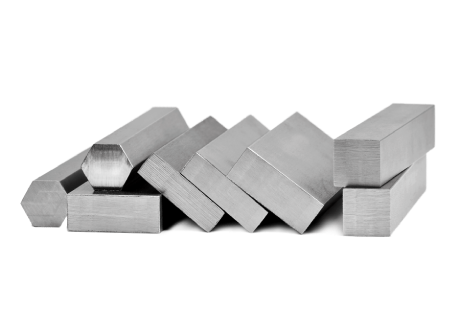
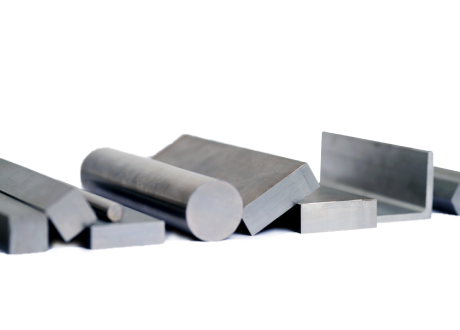
A rolled or true flat bar is produced by rolling the rectangular section as a long product. In an HRAP condition, it is hot rolled, heat treated as required for the grade and pickled to remove hot-processing scale.
The section normally has four rolled surfaces, with less-sharp longitudinal edges and more-rounded corners than an unconditioned slit product. Actual geometry depends on size, tooling and permitted tolerances rolled edges not a dimensional specification.
Width, thickness, straightness, twist, corners and surface must be assessed against the agreed standard - not against the expectation of a machined section.
What Is a Slit Stainless Steel Flat Bar?
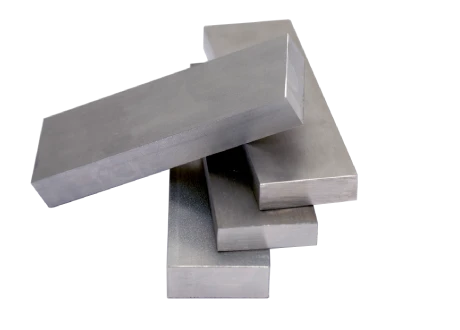
A slit flat bar is cut from a wider flat-rolled product. Its parent may be hot-rolled and pickled coil, cold-rolled coil, strip or plate. Slit flat should therefore not automatically be called cold rolled its delivery condition comes from the parent product.
The broad faces retain the parent surface and thickness characteristics. The narrow faces are cut and may show rollover, burnish, fracture and a small burr. Deburring, edge rolling, grinding or machining can subsequently alter them.
After straightening and cutting to length, this route can be efficient for repeat widths whose edges will be welded, concealed or finished.
Rolled Flat Bar vs Slit Flat Bar: A Practical Comparison
| Consideration | Rolled flat bar | Slit flat bar |
|---|---|---|
| Route | Hot-Rolled as a bar section | Cut from coil, strip or plate |
| Surfaces | Four rolled surfaces | Two parent faces and two cut edges |
| Edges | Generally rounded, within specified corner radius tolerance | May show shear marks or burr |
| Dimensions | Bar-product tolerances | Parent thickness and slit-width control |
| Best fit | Bar-specific or edge-sensitive work | Efficient repeat fabrication widths |
These are tendencies, not guarantees. Acceptance depends on the specification, tolerances and inspection results.
Where the Manufacturing Route Affects Downstream Performance
Edge condition and machining allowance
For a welded bracket, the original slit edge may disappear during joint preparation. For a machined guide, wear strip or visible detail, burr, corner shape and edge characteristics can affect tool entry, fixturing, handling and final inspection.
Rolled edges may need less dressing, but their rounded geometry can still require machining when a drawing demands controlled corners. Buyers should compare the usable section after cleanup, not only nominal size.
Thickness, width and section geometry
In slit material, thickness originates from the parent coil or plate, while width is established by slitting. In rolled flat bar, both dimensions are created through bar rolling. These products therefore need not follow the same tolerance system. Where machining allowance or assembly clearance is limited, state numerical limits for width, thickness and section geometry.
Straightness, camber and residual stress
Slitting can redistribute stresses within the parent material. Depending on coil condition, section ratio, tooling and straightening, a flat may show camber, bow or twist - sometimes more visibly after cutting, asymmetric machining or welding.
Rolled bar is not immune to shape variation. For long parts, automated feeding or tight fixtures, specify straightness, camber and twist separately from width and thickness.
Surface integrity and finishing
HRAP rolled flats generally have a functional matt, pickled surface. Slit flats carry the broad-face finish of the parent product, while their edges reflect cutting and subsequent conditioning.
Pickling removes scale; it does not create a precision-ground or decorative finish. Enquiries should identify which faces and edges will remain and what finishing they require.
Industry Reality: The Lowest Material Price Can Create the Highest Conversion Cost
Flat bars are frequently compared only by grade, nominal size and price per kilogram. That comparison can overlook the cost of converting the delivered material into usable components.
A lower-priced slit flat may become expensive if a machine shop must remove burrs, correct camber, add machining allowance or reject unstable parts. Conversely, specifying rolled bar where the edges will be welded away may add cost without improving the assembly.
Hidden costs commonly appear through:
1. Additional edge grinding or deburring
2. Slower feeding and fixturing
3. Excess machining stock and metal loss
4. Unstable tool entry or welding fit-up
5. Straightening after cutting or fabrication
6. Polishing to equalize faces and edges
7. Inspection disputes caused by an unclear product standard
The commercially correct product is the one that produces the required finished component consistently - not necessarily the one with the lowest incoming price.
Product Standards and Certification: Same Grade Does Not Mean Same Product
Stainless steel bars and stainless plate, sheet or strip may be governed by different product standards, with different dimensional rules, sampling, property requirements and certification conventions.
In ASTM-based purchasing, bars may use ASTM A276/A276M with ASTM A484/A484M, where applicable. Flat-rolled products commonly use ASTM A240/A240M and ASTM A480/A480M. European orders must similarly match the actual product form to the applicable EN standard.
A parent-coil or plate certificate does not automatically prove compliance with a separate bar standard after slitting. State the required product specification and confirm traceability from the parent material to the cut lengths.
Which Flat Bar Route Fits the Application?
| Rolled bar may suit | Slit flat may suit |
|---|---|
| Visible or functionally important rolled edges | Edges that will be welded, hidden or finished |
| Components machined on several faces | Repeat fabricated parts in efficient slit widths |
| Orders requiring a bar-product specification | Orders accepting the parent flat-product specification |
| Heavy, specialized or edge-sensitive sections | Sizes efficiently produced from coil or plate |
Brackets, frames and general fabrications may be well served by slit material. Machined parts, exposed details and specification-controlled equipment may justify rolled or further-conditioned bar. In aerospace, oil and gas and other quality-critical sectors, the approved product form, testing route and traceability must match the drawing and customer specification.
Conclusion
Both routes can perform reliably when matched to the component. Problems arise when nominal dimensions are treated as the complete specification. Machining an unsuitable edge, correcting camber or resolving a certificate mismatch all carry a cost.
The right question is not simply, which flat bar is better? It is, which starting condition gives this component the most stable and economical route to acceptance?
Learn More
At Aamor Inox, we work closely with OEMs, machine shops, distributors, and engineering teams across global industries where consistency, precision, and process reliability matter.
From stainless steel bright bars and PSQ grades to precision-engineered specialty long products, our focus goes beyond simply supplying material - it is about delivering repeatable performance across demanding manufacturing environments.
Our Nadcap-accredited heat-treatment and non-destructive testing capabilities strengthen process control, inspection reliability and material traceability for aerospace and other quality-critical applications.
Our NDT infrastructure includes emulsion-coupled ultrasonic testing and FOERSTER eddy-current testing systems. Depending on the product geometry and agreed inspection plan, these systems support examination for internal discontinuities and surface or near-surface imperfections. The applicable method, reference standard, coverage, sensitivity and acceptance criteria are agreed at the enquiry stage.
Where required, supply can also be aligned with customer-specific mechanical testing, dimensional inspection, marking, and traceability and certification requirements.
To discuss your application or sourcing requirements, share the applicable specification, dimensions, delivery condition, surface finish, testing and certification requirements with our team.
Explore more insights on stainless steel manufacturing, machining performance, quality systems and process reliability at Aamor Inox.

A-30, Site 4, UPSIDC Industrial Area, Sahibabad, Ghaziabad 201010, Uttar Pradesh, India
Plot #10, Site 2, Industrial Area, Loni Road Mohan Nagar, Ghaziabad 201007, Uttar Pradesh, India
Let’s Start Your Project