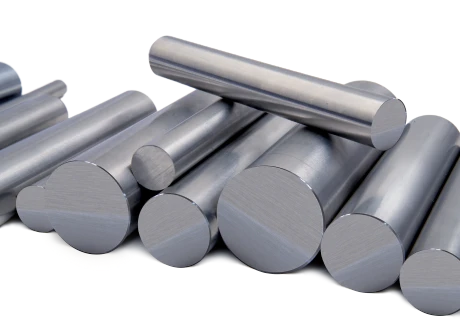

A material change from 316L to duplex stainless steel can reduce section size, improve chloride resistance and extend component life. It can also increase machining difficulty, complicate fabrication and add cost without delivering a meaningful benefit.
The grade offering the stronger datasheet is not automatically the better engineering choice.
For round-bar users, the decision must consider the complete manufacturing and service route: corrosion conditions, mechanical loading, machining strategy, welding exposure, heat-treatment history, surface integrity and inspection requirements. This article compares 316L with 2205 duplex stainless steel - the most widely recognised duplex grade - to clarify where each material creates genuine value.
316L and Duplex Stainless Steel: The Metallurgical Difference
316L, commonly designated UNS S31603 or EN 1.4404, is an austenitic stainless steel. Its low-carbon composition helps limit sensitisation risk during welding, while molybdenum improves resistance to pitting compared with non-molybdenum-bearing austenitic grades.
It is widely selected because it combines corrosion resistance, formability, weldability and established machining knowledge. For many industrial components, that balance is more valuable than maximising any single property.
Duplex stainless steel has a mixed microstructure containing both austenite and ferrite. Grade 2205, typically designated UNS S32205/S31803 or EN 1.4462, combines this dual-phase structure with chromium, molybdenum and nitrogen additions.
The result is a material with substantially higher strength than 316L and improved resistance to chloride-induced pitting, crevice corrosion and stress-corrosion cracking in many service environments.
That advantage, however, depends on correct manufacturing. Duplex performance is closely linked to chemical composition, solution heat treatment, cooling practice and control of the austenite-ferrite balance.
Duplex vs 316L Round Bars: Practical Comparison
| Selection Factor | 316L Stainless Steel | 2205 Duplex Stainless Steel |
|---|---|---|
| Microstructure | Austenitic | Mixed austenitic-ferritic |
| Strength | Moderate | Significantly higher |
| Chloride resistance | Suitable for many moderate environments | Generally stronger in demanding chloride service |
| Stress-corrosion cracking resistance | Can be vulnerable in hot chloride environments | Generally more resistant |
| Machinability | More familiar and usually easier to manage | More demanding because of higher strength and work hardening |
| Weldability | Well established with broad industry experience | Requires closer control of heat input, filler selection and interpass conditions |
| Section optimisation | Often requires a larger section for equivalent load | Higher strength may permit reduced section size, subject to design approval |
| Material cost | Usually lower per kilogram | Usually higher per kilogram |
| Fabrication flexibility | Strong general-purpose balance | Best when its additional properties solve a defined engineering problem |
| Typical selection logic | Moderate corrosion, complex fabrication and machining-led applications | Higher loading, chloride exposure and corrosion-critical applications |
This comparison is directional. Actual suitability must be established against the applicable specification, product form, temperature, stress state, fabrication route and service medium.
When 316L Stainless Steel Round Bars Are the Better Choice
Moderate Corrosion Conditions
316L remains a sound choice for many components exposed to atmospheric conditions, fresh water, food-processing environments, pharmaceutical service and moderate chemical exposure.
If the corrosion environment does not require the additional chloride resistance of duplex, moving to 2205 may introduce machining and fabrication penalties without improving practical service life.
Both 316L and duplex can work harden during machining, but duplex presents a more demanding combination of strength, toughness and cutting load.
For components requiring extensive turning, drilling, threading or complex machining, 316L may offer a more forgiving production route. Tooling, coolant delivery, setup rigidity and chip control still matter, but machining knowledge is widely established across global machine shops.
The final decision should not be based on raw-material price alone. Cycle time, tool consumption, machine utilisation and rejection risk can materially influence the finished-component cost.
Fabrication-Led Assemblies
Where a part undergoes extensive forming, welding or fabrication, 316L may provide greater production flexibility. Its austenitic structure and established welding practices make it suitable for a wide range of fabricated equipment.
This does not mean that duplex is difficult to weld. It means that duplex welding demands more disciplined control because thermal history can alter the phase balance and encourage undesirable intermetallic phases if procedures are poorly managed.
Established Designs and Supply Chains
Existing drawings, procedures and approvals may already specify 316L. Changing the grade can affect machining parameters, welding procedures, mechanical calculations, corrosion validation and customer qualification.
A technically superior alternative on paper may therefore create unnecessary commercial and qualification risk unless a clear service problem justifies the change.
When Duplex Stainless Steel Round Bars Create Greater Value
Chloride-Bearing Environments
Duplex stainless steel is often selected for seawater-adjacent equipment, desalination systems, chemical plants, offshore installations and process systems exposed to elevated chlorides.
Its resistance to pitting, crevice corrosion and chloride stress-corrosion cracking is generally stronger than that of 316L. However, “chloride resistant” should never be interpreted as “immune to chloride attack.”
Temperature, chloride concentration, oxygen content, pH, deposits, crevices and tensile stress all influence corrosion behaviour. The correct grade must be selected from actual service conditions rather than a broad industry label.
Highly Loaded Shafts and Mechanical Components
The higher strength of duplex can be valuable in pump shafts, valve components, fasteners, connectors and other load-bearing parts.
Where the design code and qualification route permit, higher strength may support a smaller section or increased load capacity. This can partly offset the higher material price through reduced component weight or improved mechanical efficiency.
These benefits must be confirmed by engineering calculation. Substituting a smaller duplex bar for a larger 316L bar without considering stiffness, fatigue, deflection, stress concentrations and corrosion allowance can create a different set of performance risks.
Oil, Gas and Process Equipment
Duplex round bars are used in environments where mechanical loading and corrosion act together. Typical applications may include pump and valve components, stems, shafts, bolting, connectors and machined pressure-containing parts.
In these applications, material reliability extends beyond grade chemistry. Bar integrity, heat-treatment condition, surface quality, dimensional consistency, traceability and the agreed inspection plan all influence the suitability of the final component.
Machining Duplex and 316L Round Bars
Machining behaviour is frequently underestimated during material selection.
316L can generate built-up edge, stringy chips and rapid work hardening if the tool rubs instead of cutting. Duplex presents similar tendencies but at higher cutting loads because of its greater strength.
For duplex machining, stable setups are essential. Tool overhang should be controlled, the cutting edge should remain engaged, and unnecessary dwell should be avoided. Effective coolant delivery and appropriate insert geometry help manage heat and chip evacuation.
The correct parameters depend on bar diameter, delivery condition, machine rigidity, cutting-tool system, operation and required surface finish. Generic speed-and-feed recommendations should therefore be treated only as starting points.
For high-volume turning or Swiss machining, bar straightness, diameter consistency, surface condition and batch-to-batch repeatability can be as important as nominal chemistry. A small variation in bar condition may affect guide-bush behaviour, tool life, concentricity and unattended machining stability.
Heat Treatment and Phase-Balance Control in Duplex Bars
Heat treatment is fundamental to duplex performance.
Duplex stainless steel is normally solution heat treated within the range appropriate to the grade, followed by sufficiently rapid cooling. The objective is to obtain the intended phase balance while avoiding harmful precipitation.
Improper thermal exposure can produce excessive ferrite, insufficient austenite or intermetallic phases that reduce toughness and corrosion resistance. These changes may not be obvious from the external appearance of the bar.
This is why grade identification alone is not sufficient. Buyers should confirm the specified delivery condition, applicable material standard, heat-treatment records and required test documentation.
The same discipline applies during downstream processing. Uncontrolled welding, hot forming or prolonged exposure to critical temperature ranges can compromise a correctly supplied duplex bar.
316L has a broader fabrication window, but it also requires correct heat-treatment and welding control. Surface contamination, sensitising thermal cycles, residual scale and poor post-fabrication cleaning can reduce corrosion performance even when the base material is compliant.
Industry Reality: The Costliest Grade Is Not Always the Costliest Component
Material comparisons are often reduced to price per kilogram. This overlooks the costs created after the bar reaches the machine shop.
A lower-priced grade can become expensive if it causes premature corrosion, excessive section weight or repeated maintenance. A higher-performing grade can also become uneconomical if it extends machining cycles, consumes more tooling or requires qualification that the application does not need.
The commercially relevant comparison is the cost of the finished, reliable component.
That calculation may include:
1.Raw-material cost and usable yield
2.Machining time and tool consumption
3.Rejection and rework risk
4.Welding and fabrication control
5.Inspection and documentation requirements
6.Equipment downtime and maintenance exposure
7.Expected service life
8.Qualification or redesign cost
9.Availability of the required bar size and condition
Duplex creates the strongest value when its higher strength or corrosion resistance resolves a known service limitation. Where those properties are not required, 316L may remain the more efficient engineering choice.
Overlooked Quality Factors in Stainless Steel Round Bars
A material certificate confirms important characteristics, but it does not describe every feature that affects downstream production.
Surface Integrity
Seams, laps, scale-related imperfections and handling damage can become rejection points after machining. Surface quality is particularly important when components are machined close to the original bar diameter.
The required surface condition should be defined at the enquiry stage rather than assumed from the grade designation.
Dimensional Consistency and Straightness
Roundness, diameter tolerance and straightness influence machining stability, especially in long shafts, centerless grinding and automatic bar-fed operations.
A bar can meet chemical and mechanical requirements while still creating productivity problems if dimensional behaviour is inconsistent.
Internal Integrity
For critical shafts, rotating components and pressure-related parts, internal discontinuities may be relevant to fatigue performance or final acceptance.
Ultrasonic testing requirements should identify the applicable method, reference standard, examination coverage, sensitivity and acceptance criteria. A general request for “UT tested material” is not sufficiently precise for quality-critical procurement.
Traceability and Segregation
Duplex and austenitic stainless steels can appear visually similar. Reliable heat identification, positive material control and traceability through cutting, heat treatment, machining and inspection help prevent grade mix-ups.
For regulated or customer-controlled applications, documentation discipline may be as important as the physical bar itself.
Application-Based Selection Guidance
| Application condition | Likely starting point | Primary reason |
|---|---|---|
| General industrial machining with moderate corrosion exposure | 316L | Balanced machinability, fabrication flexibility and corrosion performance |
| Pump shaft exposed to elevated chlorides | Duplex 2205 | Higher strength and improved chloride resistance |
| Extensively welded process assembly | 316L or duplex after welding review | Selection depends on corrosion severity and welding control |
| Marine or desalination-related component | Duplex grade assessment | Chloride exposure may exceed the practical capability of 316L |
| High-volume precision-machined part | 316L unless duplex properties are required | Total machining economics may favour 316L |
| Highly loaded corrosion-resistant connector | Duplex 2205 | Strength can provide mechanical and design advantages |
| Hot chloride service | Detailed corrosion review | Temperature, stress and chloride concentration must be assessed together |
| Quality-critical rotating component | Grade based on service, with defined inspection | Bar integrity and inspection requirements influence reliability |
These are selection starting points, not universal recommendations. Final material choice should be reviewed against the governing design code, customer specification and operating environment.
Conclusion
The choice between 316L and duplex stainless steel should begin with the component’s real operating conditions, not with a general assumption that one grade is superior.
316L offers a proven balance of corrosion resistance, fabrication flexibility and machining familiarity. Duplex 2205 provides higher strength and improved performance in many chloride-bearing environments, but demands closer attention to machining, welding and thermal history.
The most reliable selection considers the full value chain - from billet and heat-treatment control to bar finishing, inspection, machining and service performance. When those factors are assessed together, the material decision becomes clearer, more defensible and less vulnerable to hidden downstream cost.
Learn More
At Aamor Inox, we work closely with OEMs, machine shops, distributors, and engineering teams across global industries where consistency, precision, and process reliability matter.
From stainless steel bright bars and PSQ grades to precision-engineered specialty long products, our focus goes beyond simply supplying material - it is about delivering repeatable performance across demanding manufacturing environments.
Our Nadcap-accredited heat-treatment and non-destructive testing capabilities strengthen process control, inspection reliability and material traceability for aerospace and other quality-critical applications.
Our NDT infrastructure includes emulsion-coupled ultrasonic testing and FOERSTER eddy-current testing systems. Depending on the product geometry and agreed inspection plan, these systems support examination for internal discontinuities and surface or near-surface imperfections. The applicable method, reference standard, coverage, sensitivity and acceptance criteria are agreed at the enquiry stage.
Where required, supply can also be aligned with customer-specific mechanical testing, dimensional inspection, marking, traceability and certification requirements.
To discuss your application or sourcing requirements, share the applicable specification, dimensions, delivery condition, surface finish, testing and certification requirements with our team.
Explore more insights on stainless steel manufacturing, machining performance, quality systems and process reliability at Aamor Inox.

A-30, Site 4, UPSIDC Industrial Area, Sahibabad, Ghaziabad 201010, Uttar Pradesh, India
Plot #10, Site 2, Industrial Area, Loni Road Mohan Nagar, Ghaziabad 201007, Uttar Pradesh, India
Let’s Start Your Project